Rosa Lang · 29 September 2026
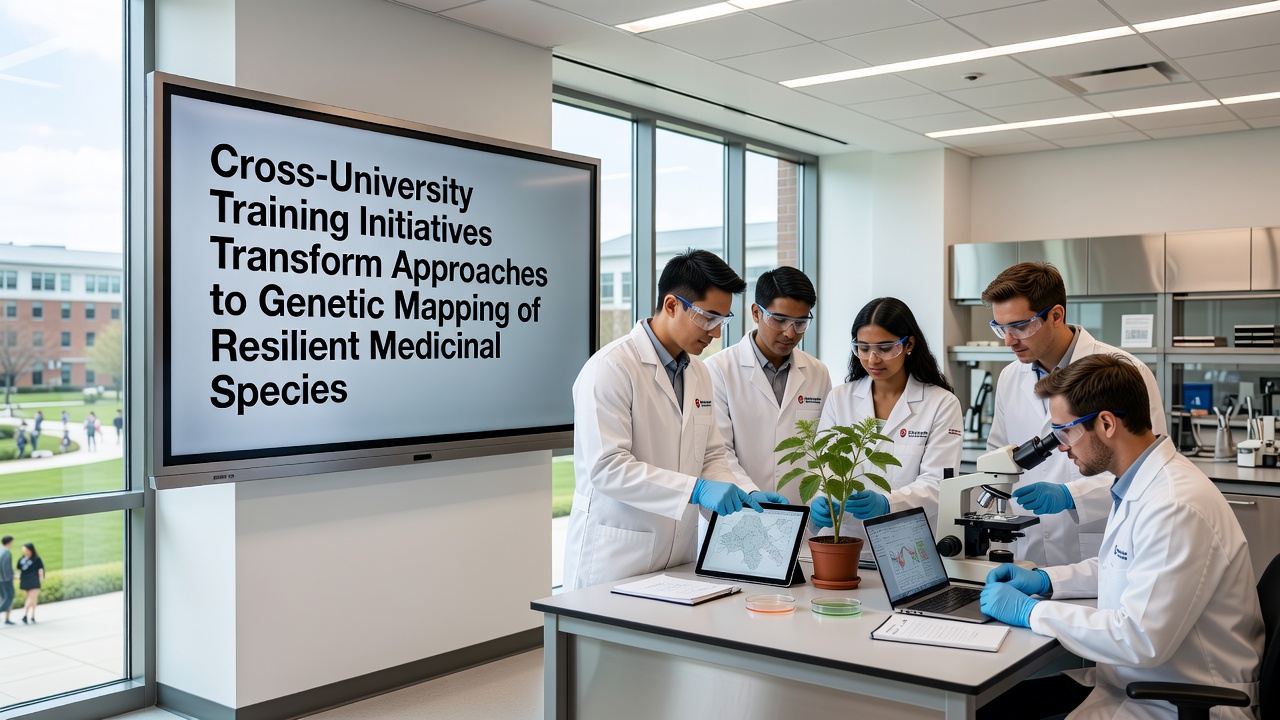
Cross-University Training Initiatives Transform Approaches to Genetic Mapping of Resilient Medicinal Species
Cross-university training programs have expanded rapidly in recent years, and these efforts now reshape how scientists approach genetic mapping for medicinal plant species that demonstrate resilience under variable environmental conditions. Universities across North America and Europe coordinate curricula that combine molecular biology techniques with computational analysis, allowing participants to handle large datasets from species such as Salvia officinalis and Hypericum perforatum. Data from collaborative projects indicate that standardized training modules improve consistency in marker identification and variant calling across different research groups.
Foundations of Genetic Mapping in Medicinal Species
Genetic mapping identifies chromosomal locations of traits linked to drought tolerance, pest resistance, and secondary metabolite production in medicinal plants. Researchers apply single nucleotide polymorphism arrays and whole-genome sequencing to construct linkage maps that reveal quantitative trait loci. Studies published through academic networks show that resilient accessions often carry specific alleles associated with enhanced root architecture and altered terpenoid pathways. These findings support breeding programs aimed at maintaining bioactive compound yields despite shifting climate patterns.
Training initiatives address skill gaps by pairing early-career scientists with mentors experienced in both wet-lab protocols and bioinformatics pipelines. Participants learn to integrate field phenotype data with genomic coordinates, which reduces errors during downstream association studies. One cohort completed a six-month exchange that produced updated reference genomes for three medicinal species previously underrepresented in public databases.
Structure of Cross-University Programs
Programs typically rotate cohorts between partner institutions, each offering specialized facilities such as high-throughput sequencers or advanced greenhouse phenotyping units. Core modules cover DNA extraction from recalcitrant plant tissues, library preparation for long-read sequencing platforms, and statistical frameworks for handling population structure. Joint seminars held via shared digital platforms allow real-time discussion of mapping results and troubleshooting of alignment algorithms.
September 2026 marks the launch of an expanded summer intensive that will run simultaneously at three sites, drawing on resources from institutions in Canada and Australia. Organizers report that registration has already exceeded prior cycles, with applicants representing seventeen countries. The schedule includes hands-on workshops on CRISPR-based validation of candidate genes identified through mapping efforts.
Impact on Research Outputs and Collaboration
Joint publications have increased since the programs began, and citation analyses reveal broader geographic reach compared with single-institution studies. Mapping projects now incorporate multi-environment trials that capture genotype-by-environment interactions more comprehensively. Evidence from these datasets points to conserved genomic regions that confer resilience across related species, which accelerates candidate gene prioritization.

Industry partners contribute by supplying proprietary germplasm collections under material transfer agreements, while academic teams provide open-source analysis tools. This arrangement has yielded publicly available variant catalogs that other groups can query without repeating initial sequencing costs. Observers note that standardized training reduces duplication of effort and supports reproducibility across independent laboratories.
Future Directions and Resource Allocation
Funding bodies have begun to require evidence of cross-institutional training plans in grant applications focused on plant genetic resources. Such requirements align with broader policy shifts that emphasize capacity building alongside discovery research. Resource sharing extends to cloud-based computing credits, which allow participants to run computationally intensive imputation algorithms without local hardware limitations.
Case examples include a consortium that mapped resilience traits in Withania somnifera and transferred the resulting markers to breeding stations in arid regions. The project timeline compressed from four years to twenty-eight months once trained personnel applied uniform protocols from the outset. Similar efficiencies appear in ongoing work on Artemisia annua, where training cohorts refined haplotype phasing methods that improved assembly contiguity.
Conclusion
Cross-university training continues to standardize methodologies while expanding the pool of researchers equipped to tackle complex mapping challenges in resilient medicinal species. Coordinated curricula, shared datasets, and joint events scheduled through 2026 sustain momentum and support translation of genomic insights into practical conservation and breeding strategies.